RV Solar Panel Installation in Palm City, FL
Here's something most RV owners in Martin County don't realize: you're sitting in one of the best spots in the entire country for solar energy. Southern Florida gets roughly 5.5 peak sun hours per day on an annual average. That means a 400-watt panel array on your roof is pulling in over 2,000 watt-hours of energy every single day. Enough to run your lights, fridge, water pump, phone chargers, and most of your 12V electronics without touching shore power or firing up the generator. We've been building RV solar systems for over 14 years, and every installation gets custom-sized to your actual energy needs. Not a cookie-cutter kit slapped on the roof.
Whether you're looking to keep your batteries topped off at an RV park, stretch your boondocking trips from two days to two weeks, or cut the generator out of the equation entirely, we've got a system that fits. And because we do full electrical work on RVs, your solar installation integrates properly with your existing 12V and 120V systems from day one.
We install solar panels, charge controllers, lithium batteries, inverters, and complete off-grid systems for all RV types. Single panel from $350, two-panel setups from $800, full off-grid builds from $2,800. Mobile service throughout Martin County. Call 772-271-5270.
Solar Panel Mounting
We install rigid and flexible panels from Renogy, Rich Solar, BougeRV, and other proven brands. Every mount uses Z-brackets or tilt frames with sealed roof penetrations. We account for AC unit clearance, vent placement, and cable routing before drilling a single hole. Flexible panels work great on curved fiberglass roofs where rigid won't sit flat. Panel mounting details
Charge Controller Installation
The charge controller is the brain of your solar system. It regulates voltage from the panels to protect your batteries from overcharging. We install MPPT controllers from Victron, Renogy, and EPever. MPPT technology pulls 15-30% more energy from your panels than basic PWM controllers, especially in partial shade. We size the controller to your panel array and battery type. Controller details
Lithium Battery Upgrade
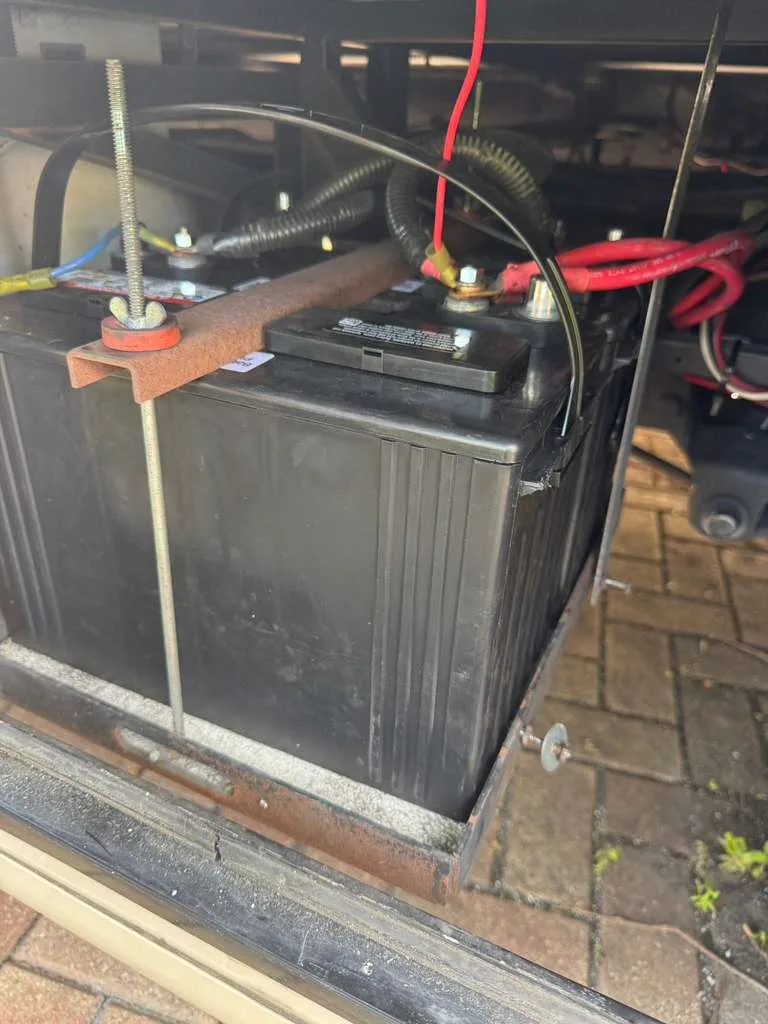
Switching from lead-acid to lithium is the single biggest upgrade you can make to your RV's power system. Lithium batteries give you 80-90% usable capacity versus 50% for lead-acid, weigh a third as much, charge three times faster, and last 3,000+ cycles. We install Battle Born, Renogy, SOK, and Ampere Time batteries. Most swaps are a straightforward one-day job. $900-2,200. Lithium upgrade details
Inverter Setup
An inverter converts your 12V battery power into 120V household current for things like coffee makers, TVs, laptops, and small kitchen appliances. We install pure sine wave inverters from Victron, AIMS, and Renogy in sizes from 1,000W to 3,000W. Pure sine wave is worth the extra cost because it won't damage sensitive electronics the way modified sine wave can. Inverter details
Battery Monitor Installation
You can't manage what you can't measure. A battery monitor like the Victron BMV-712 or Renogy 500A shows you exactly how much power you're using, how much the panels are putting in, and how many hours of battery life remain at your current draw. It's the difference between guessing and knowing. We wire these into your existing battery bank during any solar install. Monitor details
Off-Grid System Design
Want to camp for weeks without hookups? We design complete off-grid packages that combine the right panel array, battery bank, charge controller, inverter, and monitoring into one cohesive system. Every build starts with a power audit of your specific RV and camping habits. No two systems are identical because no two RVers use power the same way. Full builds run $2,800-6,500. Off-grid system details
Why Palm City Is Perfect for RV Solar
Year-Round Solar Production
Martin County sits at latitude 27 degrees north, putting it in a sweet spot for solar energy. Even in December and January, you're still getting 4+ hours of peak sun per day. Compare that to northern states where winter production can drop below 2 hours. Your panels generate meaningful power 365 days a year here, which means your solar investment works harder and pays back faster than it would almost anywhere else in the country.
Extended Boondocking Season
Florida's mild winters mean you can comfortably boondock year-round without worrying about frozen tanks or pipes. Solar makes that lifestyle sustainable. With the right battery bank and panel array, you can park at Jonathan Dickinson State Park, camp off the beaten path in Indiantown, or stay at any of the Martin County campgrounds and run your essentials indefinitely. No generator noise, no fuel costs, and no tether to shore power.
Heat and Panel Performance
Here's something worth understanding: solar panels actually lose efficiency in extreme heat. A panel rated at 200 watts produces that at a standardized 77 degrees F. On a 95-degree Florida day, the cells themselves can hit 140+ degrees, dropping output by 10-15%. We account for this temperature derating when sizing your system. Florida compensates with longer daylight hours and more clear-sky days, so the net annual production is still among the best in the nation. The NREL PVWatts Calculator confirms Palm City is in a top-tier solar zone.
Reducing Generator Dependence
Running a generator burns fuel, makes noise, requires maintenance, and in many campgrounds has restricted hours. Solar produces power silently and for free after the initial install. Most of our customers who add a 400W+ panel system with lithium batteries report they run their generator 70-80% less than before. Some stop using it entirely except for running the air conditioning on the hottest days.
How We Install RV Solar Systems
Energy Audit and System Design
Call 772-271-5270 and tell us about your camping habits. How often do you boondock? What appliances do you run? We'll calculate your daily energy consumption in watt-hours, assess your roof space, evaluate your existing battery setup, and design a system that actually matches your needs. You get a detailed proposal with component specs and exact pricing before we order anything.
Professional Installation
We mount panels with sealed, weatherproof brackets, run properly sized wiring with inline fuses and disconnects, install the charge controller in an accessible spot, wire the inverter near the battery bank, and connect everything to your existing electrical system. Every roof penetration gets Dicor self-leveling sealant. All wiring meets ABYC standards for marine and RV applications.
System Testing and Owner Training
We test every component under real Florida sun. We verify that charging rates match our design projections, confirm the inverter handles your appliance loads cleanly, and check that the battery monitor reads accurately. Then we walk you through how to read each display, what the numbers mean, and what to watch for. You'll leave the appointment confident in your system.
RV Solar Installation Costs in Palm City
Typical pricing for solar installations in the Martin County area. Every system is custom-quoted based on your specific needs.
Single Panel Install
One panel, mounting hardware, wiring, charge controller, and connection to existing batteries.
Two-Panel System
Dual panel array, MPPT charge controller, combiner box, wiring, and battery monitor.
Full Off-Grid System
Multi-panel array, lithium battery bank, inverter, MPPT controller, monitoring, and complete wiring.
Lithium Battery Upgrade
Lead-acid to lithium conversion. Battery, wiring upgrades, charge profile updates, and testing.
Solar Equipment We Work With
We use proven, well-supported brands that you can get parts and support for down the road:
RV Solar Installation Across Martin County
RV Solar Installation Questions
How much does RV solar installation cost in Palm City?
How many solar panels does my RV need?
Should I switch to lithium batteries?
Will solar panels damage my RV roof?
What kind of charge controller do I need?
Can solar run my RV air conditioner?
Does Florida's heat reduce solar panel output?
Do I still need a generator if I have solar?
How long does a full RV solar installation take?
Last updated: March 2026